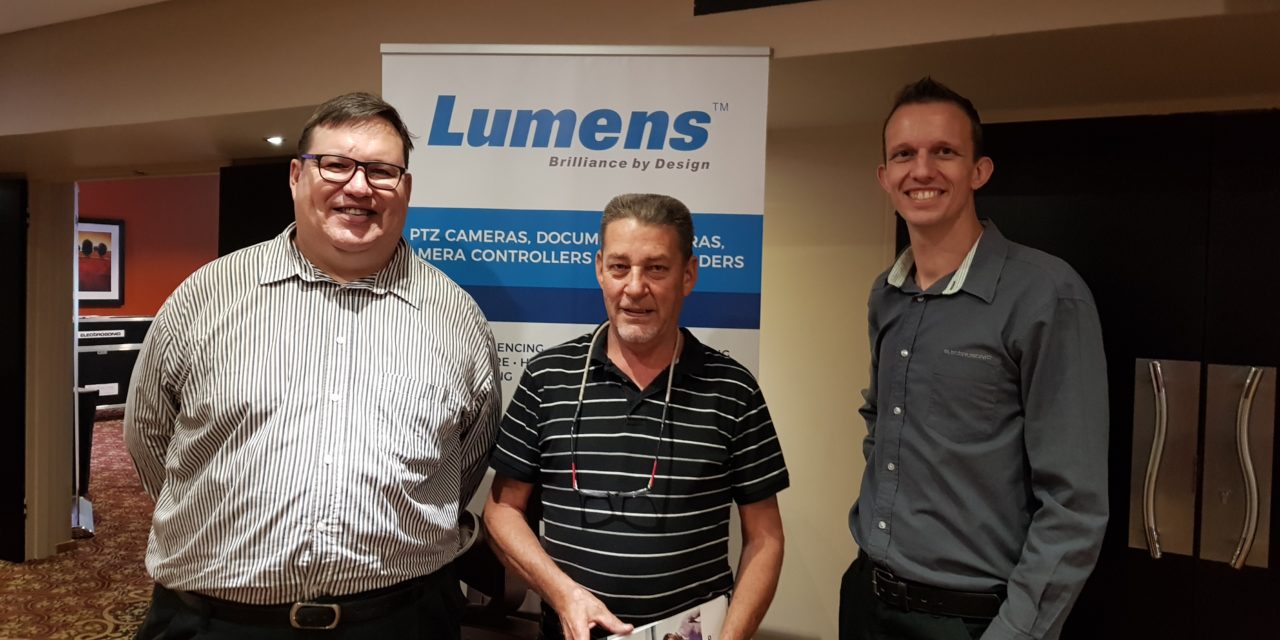
Abrie du Plooy and Lyle Tarby took to the road in the second quarter of this year with the aim of demonstrating a range of Lumens Video Capture technologies to clients across the country. Abrie shared his remarkable journey with Pro-Systems AV Integration.
En Route with the Electrosonic Lumens Roadshow
It was with great optimism and excitement that I suggested we tour around South Africa’s main metropolitan areas, showing off Electrosonic’s Lumens Video Capture technologies. The task at hand was a different animal and 4000km later I was singing a different tune.
Over and above the strenuous 49 hours on the road, the events came and went in high spirits. My colleague, Lyle Tarby and I were extremely well prepared, and we knew exactly what we wanted to achieve and how to achieve it for every venue that we had booked for the demonstration tour. Overall, it was an exciting time, and we believe that we achieved what we set out to do by demonstrating Lumens technologies to our clientele.
Lumens as a product range offers an extensive collection of video capture products. The most popular would be the range of PTZ cameras that cover various technical aspects across the arsenal of models. The first specification that sets one PTZ camera apart from the next would most definitely be the optics. Integrated optical zoom lenses, from 12x to 30x optical enlargement, were on display.
Apart from this, the range of connectivity options ensured that Lumens has a camera for every application in the range. Various Lumens cameras have a number of connections available to cover a broad requirement. The most common connection in today’s technology-driven world is IP. Most Lumens cameras are capable of IP streaming, and if an RJ45 connection is not available, there are USB options. Also, regular digital video connectivity includes HDMI, 3G-SDI and DVI as well as HDBaseT. For the analogue lovers, VGA is available on many of the models, and there are some with good old composite video. Most cameras across the lumens product range produce full HD video (1920 x 1080) however, there is a UHD option that outputs 3840×2160 over 30Hz.
As we all know, cameras only form one half of a video network, and without screens to display the captured content, the demonstration would be pretty boring and over in seconds. We, therefore, selected a few ProSpectre models to cart around on our roadshow to complete the display networks. We also took along additional screens to act as digital signage panels and double as our show marketing. All in all, we achieved a great balance between display, capture, conferencing and recording technologies.
As part of the show, we demonstrated three Lumens Document cameras. The first being a CL510 in-ceiling IP document camera, with DVI and VGA, for large area capture as well as the PS752 aimed at lecture halls and the smaller DC193, which is foldable and ideal for the salesmen/teacher on the road. These tabletop document cameras have HDMI and VGA connectivity but also connect to a notebook/laptop computer via USB and interact with Lumens software which allows on-screen annotations to be made over captured images. It also allows session recording and even has a microphone input for audio recording.
As a hardware recorder the Lumens LC102, the 4-channel recorder was on display. This capture station can record 4xIP feeds or 2x HDMI/VGA and 2xIP on an internal 1TB memory which can be expanded to 4TB external. Audio inputs are available for each input, and the desired configuration could be uploaded to a cloud or live streamed to an external recipient.
On the PTZ (Pan, Tilt, Zoom) range, Lumens has a broad arsenal, and a few of these were on display. PTZ cameras are grouped on various factors such as the optical zoom capability, connectivity or capture resolution.
Last but not least, we had a Kramer VIA wireless collaboration solution as these also tie in with the use of PTZ cameras. Kramer VIA solutions not only address the need for interactive collaboration and wireless presentation but also opens the market to video conferencing. Even though the Kramer VIA is not a proprietary codec, it allows 3rd party applications to be installed and thus interfaces with any major VC system over an IP network at a fraction of the price. For this solution, we added a USB camera and microphone directly into the VIA for a complete wireless solution, ideal for boardroom systems where one can bring your own device. Certain VIA models still allow for a physical connection as a redundant option in case WiFi networks fail.
With this arsenal in the van, we started in Johannesburg, unpacked, setup, spent all day on our feet, and broke down; packed, slept and got back on the road before daybreak en-route to Durban. Once completed in Durban, we had the convenience of a weekend with a bit of beach time before returning to the routine and setting off through the Eastern Cape towards Port Elizabeth where we completed our routine for a Monday show. We spent Tuesday on the garden route, Wednesday in Cape Town, Thursday on the endless road towards Bloemfontein, where we completed the away leg and made our way home that same evening. Back in Jozi, we contacted our resellers and arranged the grand finale over two days at the Electrosonic offices in Northcliff.
All in all it – the roadshow was a great success. We managed to take a lot of our product directly to our resellers and with intensive and personal demonstrations got the best out of this show. If any of our resellers missed the opportunity to see our products, be sure to give us a call for a personal demonstration.