
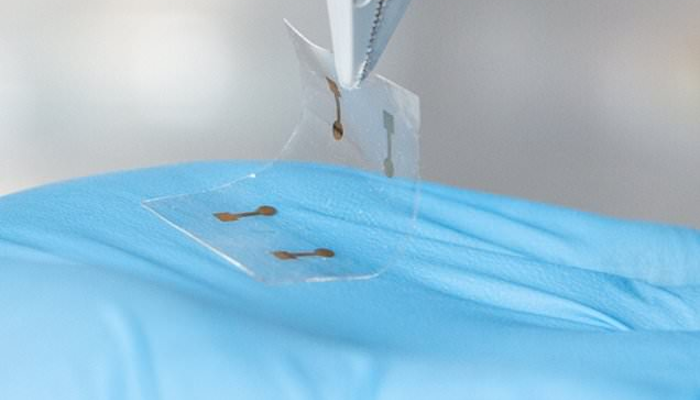
According to a report published by Science Daily: “Researchers have developed an ultra-thin and ultra-flexible electronic material that could be printed and rolled out like newspaper, for the touchscreens of the future.”
The research team behind the breakthrough, with members from the University of New South Wales, Monash University and the ARC Centre of Excellence in Future Low-Energy Electronics Technologies (FLEET), originally published their findings in the journal Nature Electronics.
The press release from Science Daily continued: “The touch-responsive technology is 100 times thinner than existing touchscreen materials and so pliable it can be rolled up like a tube. To create the new conductive sheet, an RMIT University-led team used a thin film common in cell phone touchscreens and shrunk it from 3D to 2D, using liquid metal chemistry.
“The nano-thin sheets are readily compatible with existing electronic technologies and because of their incredible flexibility, could potentially be manufactured through roll-to-roll (R2R) processing just like a newspaper.”
Lead researcher Dr Torben Daeneke told reporters that “most cell phone touchscreens were made of a transparent material, indium-tin oxide, that was very conductive but also very brittle.
“We’ve taken an old material and transformed it from the inside to create a new version that’s supremely thin and flexible,” said Daeneke. “You can bend it, you can twist it, and you could make it far more cheaply and efficiently that the slow and expensive way that we currently manufacture touchscreens. Turning it two-dimensional also makes it more transparent, so it lets through more light. This means a cell phone with a touchscreen made of our material would use less power, extending the battery life by roughly 10%.”
The research team have now used the new material to create a working touchscreen, as a proof-of-concept, and have applied for a patent for the technology. The material could also be used in many other opto-electronic applications, such as LEDs and touch displays, as well as potentially in future solar cells and smart windows.
“We’re excited to be at the stage now where we can explore commercial collaboration opportunities and work with the relevant industries to bring this technology to market,” Daeneke said.
To read more about this breakthrough technology, please click here.