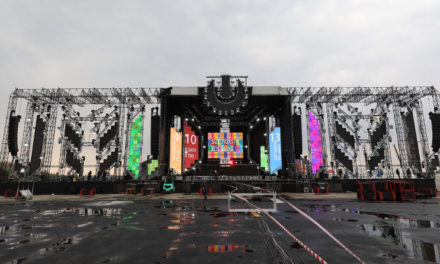
Tomorrowland is one of the world’s highest profile electronic music festivals, gathering
over 400.000 people at the main site in Belgium, and connecting an additional 70.000
people at multiple remote venues through the UNITE event. UNITE are events
organised in different countries and connected via a live satellite broadcast with
Tomorrowland Belgium.
This year UNITE shared three hours of live HD video broadcast feeds featuring
performances from the main stage in Belgium, with remote live parties in Germany,
Malta, Dubai, Israel, South Korea and Lebanon. At each location, grandMA2 consoles
were in control. In Belgium 13 x grandMA2 full-size, 8 x grandMA2 light, 1 x
grandMA2 ultra-light, 2 x grandMA2 fader wing, 2 x MA onPC command wing and 1 x
MA onPC fader wing were used.
Up until 21h00 Belgium time, every party had their own DJ performances. Starting at
21h00 the live video from Tomorrowland Belgium was sent to the different locations
for the audiences to watch. In parallel, the local lighting rigs – that were smaller than
the main stage were used to reproduce in the best possible way the same colours and
strobe effects as were happening in Belgium. All other parts of the lighting were
controlled by the local operator at each venue.
Technical designer Mario Hofman evaluated the live images taken from the different
venues during last year’s edition of the festival and wanted to increase the “united
experience’ for this year. The idea arose of having a virtual operator assisting the
worldwide local operators. For the 2017 edition of the festival, Hofman wanted the
overall ambience of the remote stages to follow the main colours and colour effects
that were being created by Leon Driessen, main stage operator in Belgium.
In a combined effort, MA Lighting’s Belgian distributor FACE and MA Lighting picked up
on the idea and choose a software to connect the lighting across all the venues
worldwide.
To achieve this, a trigger was generated from a grandMA2 on the main stage in
Belgium and sent over a network connection to the backstage media village. From
there the data was bounced to every worldwide participating venue over the internet
and used as an external trigger source for the local MA desks.
The audio and video, however, were sent via satellite feeds with various latencies. As
the lighting control data came over the web, each local venue used the trigger to
synchronise the data streams. This allowed a perfect replication of the colour
sequences and flashes being generated from the main stage with the live video and
audio feeds across the globe.