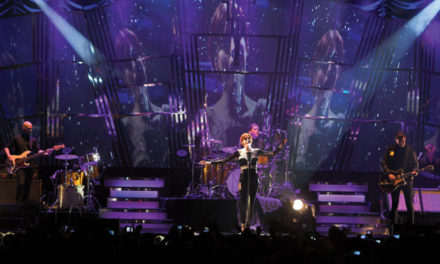
The launch of Media 24’s Grazia magazine in South Africa was a glittering high tech event, which featured an impressive 360 degree panoramic projection. The event was held at the Phoebus Apollo hanger at Rand Airport in March and was attended by some 300 local and overseas invitees.
The Sound Syndicate, creative brains behind the event, were asked to take the Australian launch model and apply it to the launch of the South African publication.
Penny Wilson of The Sound Syndicate explains: “Our brief from Grazia was to use the same concept used for the Australian launch. We were shown the video of what they had done which featured a 360 degree screen and we were asked to adapt this to the local market.’ They called in Tony E’ Silva of Midrand-based Leisure Tech Lighting who supplied the technical that helped make their ideas come to life.
The Phoebus Apollo hanger was an ideal venue to cater for the space and height requirements of the event. After looking at the DVD of the Australian launch, E’Silva found that the physical structure of the screen and centre piece was complex. The hanger, although fine size-wise, did not have a roof structure strong enough to support all of the equipment required, so a scaffolding tower was built in the centre. The staging was also quite different to the Australian model – with the bar and fashion ramp in the centre.
The Ministry of Illusion (MOI), a top end post and effects company, was brought on board to provide all the visual material. Co-owner Gerd Muller explains: “We created a seven-minute visual spectacle promoting Grazia’s launch into South Africa. Grazia supplied us with the raw elements which we animated and brought to life over the seven minute run of the visual material.’
A Coliseum effect was projected in 360 degrees and various elements moved around this — including taxis, the South African flag, a train and other elements.
The Grazia chief editor was filmed in studio against a green screen which enabled MOI to magically have her appear from within the 3D projected coliseum structure and step out onto a podium welcoming all the guests to the launch event, a definite highlight.
“The main challenge was how to integrate content across 10 separate HD projectors to ensure the storyline remains in sync for the duration of seven minutes,’ adds Gerd. This was well received as MOI had done something similar for a launch of a similar nature in the past.
MOI handed 10 x HD video streams of content in Mpeg 2 format to Sound Stylists Clint Fowler, a projection specialist who spent hours behind the scenes to ensure every pixel was looked after while Mickey Perreira from Mix Audio handled the surround sound.
A small demo version of all the screens was set up which enabled the team to view the visual content prior to the event and make adjustments to any photo sizes, content and colours used. The content for these projections were in full HD – the best quality for a really breathtaking visual experience.
The Sound Syndicate brought Sound Stylists onboard to provide the projection and control equipment. 10 x 20000 lumens and 1080p HD three-chip DLP Barco HD Projectors were supplied with a Vista Spyder as an interface between playback and projectors. A Wings Media Server was used with a total of 16 outputs. An Apple Macbook Pro served for all static logos and control. All projector cabling runs were done by fibre optics so the visual content was uncompromised.
Visual footage was loaded days in advance on the Wings Media playback system. From there HD content was fed on different outputs of Wings into the Vista Spyder. This unit is used to adjust images to size and routes inputs to output. This is also a fail-safe in case technical problems arose so they could switch the multi screen to the Grazia logos and graphics.
In Wings the different videos were dragged into timelines, each video for each section of the 110m prepared screen surface. Audio was also fed from there. The surround sound set up had numerous sound effects at different times. The visuals had taxis, flags and trains, and if the train went past on the left, audio was added in the time lines to only pass on the left side of the sound system. All the projectors were networked to align all of the screens. This gave the technician the capability to sit in the venue with a Macbook and adjust all the colours and sizes of each projector individually. This is also used to monitor each projectors’ lamps and temperatures and all power related issues, crucial on high end events.
Once the projection team had completed the set up of the projection and control gear, they spent hours checking to ensure that every frame and every screen colour was the same. “I would say that this launch was surely one of the largest HD 360 degree projections undertaken,’ says Fowler.
The Leisuretech crew then set about creating the 360 degree screen. For this they used 10 panels each measuring 11 metres wide and eight metres high – creating a total circumference of 110 metres. Once the frames were built, the locally made material was stretched over the frames. Everything was built off site and then taken to the hanger and assembled there. “The assembly was not problematic,’ says E’Silva.
The 360 degree seamless screen also differed from the Australian version which had gaps in between. The tunnel created for walking into the centre area was closed up for the actual projection. The screen was not actually a perfect circle. Each panel was around 36 degrees to each other, however it was quite difficult to detect this.
The actual event featured a fashion show as well as a live performance by the band Good Luck but the main focus of the entire event was the 360 degree projection.
“When you consider the short lead time, the fact that we had client approval only four days before the launch, was quite a feat,’ says E’Silva. Quite a feat indeed!